Research
Historical Reference or Artistic Invention?
A practical method for separating documented motifs, modern borrowings and entirely fictional decoration.
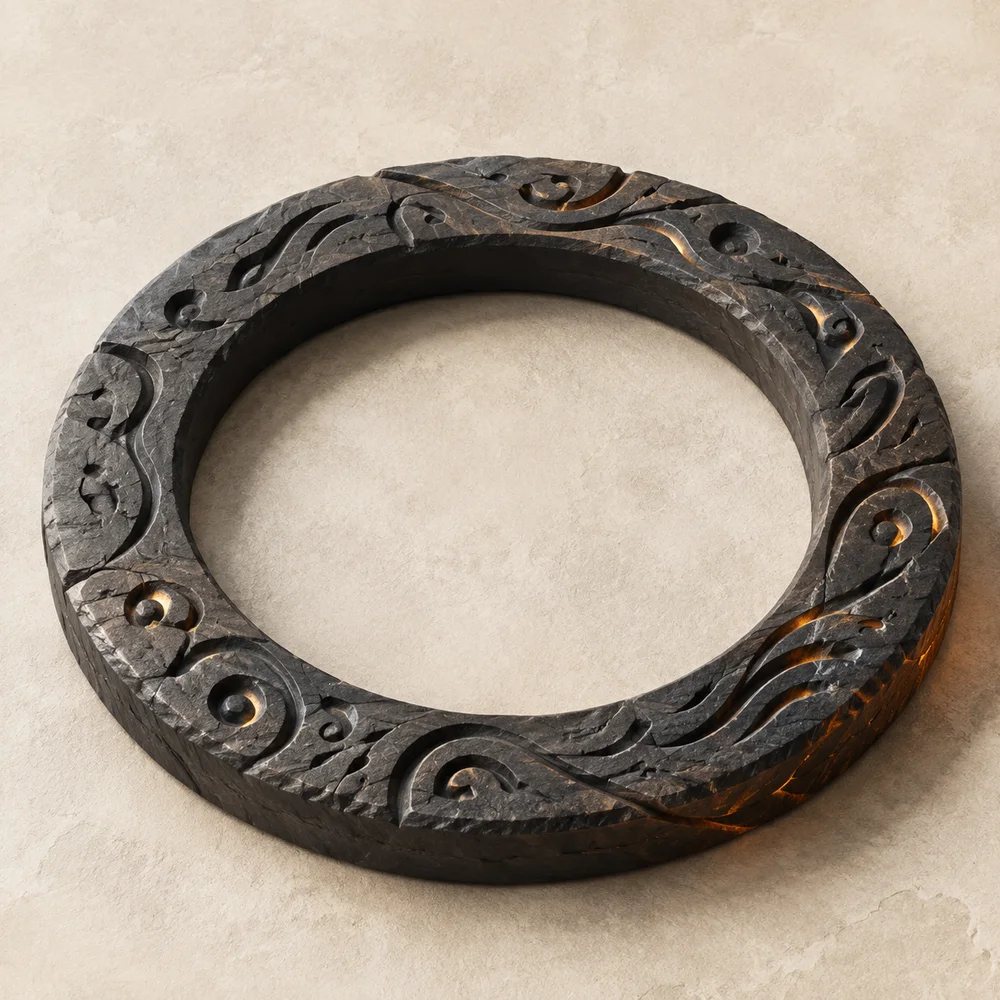
Fantasy art often looks old on purpose. Weathered stone, circular borders and angular marks can evoke distance and authority without reproducing any documented object. Appearance alone cannot establish origin. The reader’s task is to separate what is visible, what the maker states and what a reliable record confirms.
Write down only what you can see
Begin with neutral description: a dark circular border, repeated incised marks, a central winged figure and orange rim light. Avoid names such as rune, temple seal or ritual emblem until evidence supports them. Description is not timid; it creates a clean base for later interpretation.
The National Gallery of Art’s educational material defines a symbol as a form that represents something else. The crucial next question is where that relationship is established. It may come from a documented tradition, an artist statement, a story inside a fictional world or the viewer’s own association.
Look for an object record
For historical works, prefer a museum or collection record that identifies maker, date, material, dimensions, provenance and bibliography. Getty’s controlled term “roundel” describes a class of circular architectural panels, but it does not convert every digital circle into architecture.
If a database lists an attribution as unknown or uncertain, preserve that wording. Do not solve uncertainty by comparing the object with an image that merely looks similar. Visual resemblance can guide a research question; it is not provenance.
Keep traditions in their own contexts
Herodotus’s account, a medieval European bestiary and a late Ming Chinese phoenix tapestry come from different languages, purposes and social settings. Placing them on one page can illuminate contrast, but a responsible caption does not treat them as chapters of one standardized myth.
Translation adds another layer. “Phoenix” may be a convenient English label for a different named being. Retain the culture-specific term when it matters, cite the collection’s language and explain the limits of the comparison.
Label the new work clearly
The carved marks in this journal’s artwork are fictional decorative forms. They were generated for a contemporary editorial project, carry no translation and are not offered as a reconstruction. That direct statement prevents atmosphere from becoming false authority.
A transparent credit should name the production method, date and rights status. If the publisher cannot verify its licence, the image should remain unpublished. Modern invention is not a flaw; it becomes misleading only when presentation disguises it as documented history.
Working takeaway
Describe first, verify second and interpret third; never promote visual resemblance into provenance or translation.
Sources and scope
These references support the historical and terminological framework. They do not endorse this publication or its illustrations.
- Perseus Digital Library, Tufts UniversityHerodotus, Histories 2.73
Ancient Greek literary account of the phoenix, including Herodotus’s explicit distance from the report.
- The Metropolitan Museum of ArtA Medieval Bestiary
Medieval bestiary treatment of the phoenix and its Christian resurrection reading.
- Getty Research InstituteArt & Architecture Thesaurus: roundels
Terminology for circular decorative panels in architectural settings.
- The Metropolitan Museum of ArtPanel with a Phoenix and Birds in a Rock Garden
Collection record for a late Ming Chinese tapestry; useful for keeping the fenghuang context distinct.
- National Gallery of ArtThe Elements of Art: Symbolism and Place
Introductory framework for distinguishing a visible form from the idea assigned to it.